Reporter: McKenzie Martin
Email Address: mmartin@kktv.com

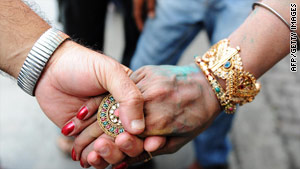
NEW DELHI, India (CNN) -- Indian election authorities Thursday granted what they called an independent identity to intersex and transsexuals in the country's voter lists.
Before, members of these groups -- loosely called eunuchs in Indian English -- were referred to as male or female in the voter rolls.
But now, they will have the choice to tick "O" -- for others -- when indicating their gender in voter forms, the Indian election commission said in a statement.
"Enumerators and booth-level officers (BLOs) shall be instructed to indicate the sex of eunuchs/transsexuals etc as 'O' if they so desire, while undertaking any house-to-house enumeration/verification of any application," a statement from election authorities said.
India, home to more than 1 billion people, has 714 million registered voters.
Intersexual people are seen as a marginalized community in India. Many end up begging on the streets, becoming prostitutes or earning their livelihood by dancing at celebrations.
In July, an Indian court delivered a landmark ruling legalizing gay sex between consenting partners in the country.
The July verdict meant the law -- Indian penal code section 377, which had previously criminalized consensual homosexual acts between adults -- was partly struck down but remains in place as far as forced homosexual acts are concerned.
It was not clear whether the ruling -- which was later challenged by an astrologer in India's highest court -- would eventually lead to legalization of gay marriages in the country.

Image meant to 'poke fun' at Malema 'racist, sexist'
Nov 10, 2009 10:34 PM | By LAUREN COHEN and NIVASHNI NAIR
Satirical T-shirt company Laugh it Off posted an electronically doctored image of Sara Baartman's body featuring male genitalia and Julius Malema's head - in a bizarre attempt to ridicule the ANC Youth League president.
The image, titled "Hermafrotiet", was posted on the Laugh It Off website because the company is "considering some [Julius] Malema T-shirts and is testing the market".
But the government yesterday described the posting as "tantamount to laughing about the Holocaust".
Laugh It Off spokesman Ruan Kemp said the image, which he designed in "a few minutes", was "meant to poke fun at Malema" and comments he made regarding the Caster Semenya debacle, in which South Africa's women's 800m world champion was forced to undergo gender testing.
Malema said that "hermaphrodites do not exist" in his language, Pedi, and therefore Semenya was not a hermaphrodite as claimed in international media.
Baartman was shipped to England in the 1800s, given the name Hottentot Venus and paraded as a sexual freak before the public.
After her death, parts of her preserved body were exhibited in a museum in France.
Her body was returned to South Africa in 2002.
But Kemp says he meant to ridicule Malema - not Semenya or Baartman.
"The media handled it [the Semenya issue] as though she was a freak. I used the image of Baartman and put Malema's head on to question who is the actual freak. I am drawing parallels between what she went through and what Caster went through," Kemp said.
"They are both strong women with a lesson to teach us," he said.
Kemp said people were "offended by different things".
But Oageng Tsatsi, a visitor to the website, was not impressed.
"I am shocked - is this allowed? Is it even funny?" she commented on the website blog.
Lisa Vetten, a researcher for the Tshwaranang Legal Advocacy Centre, said she did not "get the joke".
"The image displays the long and ugly history of eroticising and presenting black women's bodies in a freakish way and that is racism and sexism."
Last night, after The Times contacted Laugh It Off, the company tried to contextualise its posting by adding to it Malema's comments about hermaphrodites.
Sibani Mngadi, spokesman for the ministry of women and children, said: "Whoever thought this was a joke, has no regard for the traumatic history of exploitation of African women.
"The graphic undermines the efforts that have been made to restore the dignity of Sara Baartman. The insinuated link to the recent abuse of Caster Semenya makes it even more disgusting."
Malema did not comment at the time of going to print.
More information: Click here
NEW ZEALAND DAILY NEWS
Sunday of solidarity for intersex people
By GayNZ.com Daily News Staff
8th November 2009 - 11:31 am
Today, Sunday 8 November, has been dubbed international 'Intersex Solidarity Day', to raise awareness of the existence of intersex people and the issues they face.
South African Olympic runner Caster Semenya, 18, made headlines recently when the results of a gender test outed her as being intersex. The Intersex Awareness New Zealand network believes more than one in 2,000 people in the general population also have genetic and physical variations placing them in between male and female.
"Imagine one end of the bench represents being 100% male, the other 100% female and you can't sit either end, you may be intersex," says Intersex Awareness NZ. "If so you are not alone, 2000 other New Zealanders are sharing the middle with you."
Wellington-based psychotherapist Mani Mitchell, who is herself intersex, told her story in the latest issue of Marie Claire magazine - describing how her mother was told Mani was a 'hermaphrodite' when she was born, and shoes to bring her up as a girl.
"I don't see myself as exclusively female or male, but I also know generally how uncomfortable the world is with difference," she explained.
For information on Intersex Solidarity Day: Click here

First Published : 07 Nov 2009 10:34:00 AM IST
Ins Kromminga has been in Delhi for the past few days. He/she was the guest artist at the Nigah Queer fest ‘09. The fest, which has partially collaborated with the Max Mueller Bhavan, New Delhi for the past two years has had one artist from Germany every year. Ins Kromminga is an artist and activist who works on a range of issues concerning intersex persons. He/she is the German spokesperson for the Organisation of Intersex International.
I whisked him/her away for a while during the Nigah picnic, at Nehru park in Delhi, the closing event of the fest this year. Below are Kromminga’s opinions on intersex persons’ issues and the role of art in the same.
What is “intersex”?
I will try and explain this complex aspect in as simple a form as possible. It is a biological reality where a person’s body integrates parts that are usually considered to be “female” and “male”. This can be at multiple levels. It can be in the genitalia, chromosomes, and the genetic system on the whole and so on. There are many variations in this continuum. Medical science has identified eight categories to determine any human being’s sex and all persons have to fit within these to make a clear cut call on a person’s gender. And thus, presumably, most people will not fit perfectly within these minimalistic paradigms. The term itself comes from medical science. Before the emergence of the term ‘intersex’ the term used commonly was ‘hermaphrodite’. Since 2005, it has been called Disorder of Sexual Development (DSD) by some, following a medical convention where this term was proposed and accepted by the delegates. Intersex activists have resisted this term vehemently; the reasons are rather obvious. Essentially, the term pathologises our bodies even further. As a result of this change, intersex has now become a term used by us with pride and as our identity.
What would you say are the basic issues with regards to intersex people?
The basic demand is that no harm is done to persons irrespective of their genders at birth and later. Second, we have always demanded that there be no intervention in terms of surgery or hormonal therapy on any person without the full consent of the person in question. It should not be a choice made by parents, as it is impossible for parents to imagine their child to be neither male nor female, given the current social conditioning and stigma. Sometimes, intervention is needed due to other health concerns that are inevitable. However, the medical establishment is not capable of differentiating between normative notions of what a body is to look like and other health issues. The broad politics of most parts of the movement is to work towards a world where society, law and politics should be aware that there are not just men and women, as society is not that simple. There is a constant focus on ‘fixing’ the problem without even telling the person what is being done to them. We argue that being intersex is not a ‘problem’ by default but is only, sometimes, one of the many causes for broader health issues.
Please give us a brief overview of your own life as an intersex person.
I was born like a “girl”. Raised as one as well. When I turned 13, I had hair growth and there were changes in my genitalia. My menstruation also did not start. It was when I was 17 that I finally went to a doctor. The doctor frankly and rather rudely declared that I was confusing. As much as it hurt, it was at least clear and direct. I was asked to consult some specialists who told me that my “ovaries” have to be removed, as they may get cancerous causing danger to my life. I consented to the surgery, as a life threat is obviously a reason enough to do so. I realise later however that my so-called ‘ovaries’ were actually internal testes, which cause no danger to my life, and I could have lived healthily with them. I was lied to by the doctors in order to keep my gender as a ‘female’ intact, a choice they made for me and not me for myself. They presumed that right by virtue of me being intersex. The process of the medical check ups is often violative to all intersex people irrespective of age and I faced some parts of it also. I was made to undress and stand in front of a medical grid and pictures were taken of me. Intersex people are made to be specimens on a regular basis for doctors and medical students without their consent. Some little children have surgeries performed on them where for instance a ‘vagina’ is constructed and dildoes inserted into them on the regular basis to make their ‘vaginas’ as ‘real’ as possible. This act, which amounts to rape essentially, is performed in the name of medical treatment. Many who have gone through this process are traumatised for years to come if not for the rest of their lives. Most of these procedures are not needed for their health and well being but only to determine their gender as one or the other and to maintain it that way. It is a violative heteronormative notion of what ‘female’ and ‘male’ bodies should look like and how they are to live their lives that informs these practices. For instance, an intersex person who is made into a woman is not just a woman but also a heterosexual woman by default.
Can you give us a brief outline of the intersex movement in Germany?
It began in 1996 when Michel Reiter along with others started the Working Group Against Violence in Pediatrics and Gynecology. They initiated and ran campaigns critically and openly through flyers, articles and films. One of the first organisations in the world is the Intersex Society of North America (ISNA), which is now defunct. I am the German spokesperson for the Organization Intersex International which works in many countries across the world including Australia, South Africa, Uganda, South America, Palestine, Tunisia, Taiwan and so on. We also have a contact person at Ekta, an organisation based in Mumbai, India. The intersex movement has been inspired by the women’s movement and the queer movement in Germany. It is informed by feminism. The continuum in the oppression of LGBT people’s rights and that of intersex people is blatantly clear. Even in Germany, when much of the LGBT persons are apolitical, we argue that if doctors could decide the sexual orientation of a child (the way they decide the gender and birth) or later, LGBT people need to remember that parents will still choose heterosexual children.
What do you see your role as an artist in this process?
As an artist, I express myself based on those things that I see. The absurdity of the fixing of genders and the policing that is needed leaves one with a whole host of material for the creation of art. Hopefully, putting them out there visually will challenge existing notions of gender in society and make a case for all those who live lives without fixed genders and for all others who hope to create a society where the binary notion of gender is broken down.
Ins Kromminga from his/her own experience has given us a brief overview. There are millions of intersex children, teenagers and adults in India as well who are not even within our world view. We have no details about these people whatsoever. The queer and feminist movement has to incorporate within it the lives of intersex people. More importantly, we need to acknowledge fully the absurdity of the attempt to simplify and codify society, in terms of gender in this case, and the oppressions and exclusions it causes. About time we see and acknowledge the brutal violence of the gender binary and stand up for a complex world with people of various genders and sexualities.

By Neil Wilson Last updated at 1:28 AM on 06th November 2009
Caster Semenya has received an unconditional apology from Athletics South Africa for their mishandling of the gender row which followed her 800metres win at the World Championships.
ASA president Leonard Chuene, the board of ASA and its members have been suspended by the country's Olympic governing body pending a disciplinary investigation into the affair.
Six weeks ago Chuene refused to resign despite admitting he had lied when he said there had been no gender verification tests carried out on Semenya, 18, before the Berlin event.
Semenya, who had improved 15 seconds in 12 months, was acclaimed as a national hero on her return from Germany. There was outrage in South Africa when it emerged the IAAF world governing body had carried out a gender test.
Yesterday's apology is the first implicit admission the fault lies in South Africa. It is now accepted that tests on Semenya before the World Championships - showing she had three times as much testosterone as a normal woman - led to ASA's doctor recommending she be withdrawn.
The IAAF's own tests in Berlin are believed to have found Semenya has male and female characteristics and she could be stripped of her medal. It is more likely a second gold will be awarded to Kenya's Janeth Jepkosgei, with Semenya being told she could return to the sport after surgery and one year's treatment.
For more information, click here.

This month (November) the Canadian city of Toronto will host the III World Congress on Hypospadias and Disorders of Sex Development. The conference runs from Thursday, November 12, 2009 - Sunday, November 15, 2009.
Among some intersexed groups it is colloquially becoming known as “Hack 'n Hope”.
The Hack 'n Hope
Whilst the Disorders of Sex Development (DSD's) terminology is contentious - at least among many of those to whom it is applied - Hypospadias repair in its more common forms is not. In most circumstances hypospadias repair does not attempt to 'assign' a so-called gender identity and gender role to a child. That said there is no good evidence that males will grow up doubting their masculinity if they need to sit down to pee because of hypospadias.
Despite the dearth of substantive evidence that genital surgery is necessary for psycho-sexual development the highlight of the Toronto (Hack ‘n Hope) conference is touted as 'SURGICAL DAY'.
Surgical Day is Thursday, November 12, 2009 and features: "All day – Live Surgery (hypospadias and feminizing genitoplasty cases with simultaneous broadcasting from 3 operating rooms. If cases for feminizing genitoplasty are not available we are going to present videos with the repair).
If the Feminizing Genitoplasty involves gender assignment there is a 33% chance that its infant recipient will reject it in adolescence or adulthood. It may also involve a clitoral reduction because that highly enervated organ dare not extend beyond an arbitrary average without becoming 'read' as penis, and cut down to an acceptable size.
As we see, the new terminology, DSD or Disorders of Sex Development, is a form of semantic terrorism that experts have used to justify mutilation and sex assignments without consent.
WHAT IS SEMANTIC TERRORISM?
Semantic Terrorism:
1. The willful or reckless perpetuation of beliefs or stereotypes, orally or in writing, that undermine the public and personal safety or well-being of a target group.
2. The spreading of pseudo-scientific opinions and psychological theories that negatively impact on any target group, or that create or stimulate social apprehension directed toward that group.
3. The creation of a public or social sense of danger and/ or uncertainty through the assumption of knowledge and power over a target group, such as to discredit them and remove both their autonomy and their ability to reasonably predict their own outcomes.
Adapted from:
http://trans-fried-fluff.blogspot.com/2009/11/dsm-v-revision-paper-4.html