Thursday, November 19, 2009

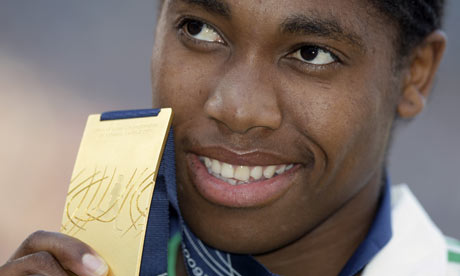
Caster Semenya found 'innocent of any wrong' to retain 800m gold medal

• Semenya to keep 800 metres gold medal and prize money
• IAAF accepts resignation of Athletics South Africa president

guardian.co.uk, Thursday 19 November 2009 11.59 GMT

The International Association of Athletics Federations has agreed that the South African runner Caster Semenya will keep her 800 metres world title, the country's sports ministry said today.

The 18-year-old Semenya, who stormed to victory in August's world championships in Berlin, underwent gender verification tests this summer in South Africa and Germany and a panel of experts has been studying the results for the IAAF.

South Africa's government, Semenya's lawyers and the IAAF had reached total agreement that she will retain her gold medal, title and prize money because she has been found "innocent of any wrong", the ministry said in a statement.

Agreement was also reached with the IAAF that scientific gender tests conducted on Semenya will be treated as confidential and there will be no public announcement of the results.

The IAAF said it could not confirm the details in the statement but said it had accepted the resignation of the Athletics South Africa president, Leonard Chuene, from the IAAF Council and had opened a formal investigation into the handling of the Semenya affair by Chuene and the ASA.

Chuene and his board have been suspended by South Africa's Olympic governing body pending an investigation after Chuene admitted he lied when he denied Semenya had undergone gender tests before the world championships.

The sports ministry said Semenya would decide her future on her own. "The implications of the scientific findings on Caster's health and life going forward will be analysed by Caster and she will make her own decision on her future. Whatever she decides, ours is to respect her decision."

They had also requested that the IAAF apologise for the way the Semenya saga had been handled. "Their response is: 'It is deeply regrettable that information of a confidential nature entered the public domain.' The IAAF is adamant that the public discourse did not originate with them."

Australia's Daily Telegraph, citing an unnamed source, reported in September that Semenya was a hermaphrodite with both male and female sexual characteristics. The IAAF has not confirmed the report.

Semenya and family members say the runner is female and that publicity surrounding the case has caused hardships. South Africans have reacted angrily to the case and the country's ruling African National Congress has denounced the IAAF and the ASA for their handling of the matter.

Source

Caster Semenya and the middle sex

As athletic leaders meet to decide the sex of the South African runner, our writer reveals that the NHS has pioneered a new approach to the hundreds of UK babies born each year of unclear sex

Excerpt. Sophia from OII-UK

When Sophia, 45, from Brighton, was born with a genetic condition (called 5-ARD) that made her sex initially unclear, her parents were told nothing. This secrecy by the medical teams was absolutely standard. “They didn’t know what I was, but all they said to my parents was, ‘there’s a problem, we’re doing some kind of repair’.”

She was sent home to an almost impossible life. Her parents were told she was a boy, but they “picked up something strange was going on”. Meanwhile the botched “repair” made life as a boy utterly miserable.

In adulthood Sophia now lives (“exists” is the word she uses) as a woman, campaigning passionately against surgery to “normalise” babies. Wouldn’t it be kinder, I ask, to make a child less different in the eyes of their peers, to spare the taunts? “That argument is countered by the messiness the surgery itself causes,” she says.

Complete article: Click here

Wednesday, November 18, 2009

INTERSEX IDENTITY PROCESS SIMPLIFIED


Category:
Community
Author:
Ani Lamont
Posted:
Wednesday, 18 November 2009

New South Wales has become the second state in Australia to allow intersex people to change the sex on their birth certificates.


Organisation International for Intersex (OII Australia) president Gina Wilson said the changes will ease the burden around all identity issues, and could place pressure on other states to follow suit.

Previously in NSW the sex registered on a birth certificate could only be changed if it was deemed there had been a gross clerical error that was spotted within weeks of a child’s birth.

Following a landmark case in which a person who had been living as a man for 40 years successfully applied to have the sex on his passport changed from female, NSW Births Deaths and Marriages has adopted a new policy towards intersex customers.

Now people need only provide proof that they are intersex and are living in the gender they wish to change to for their official documents to be changed.

“They say that they are not the people who assign genders or sexes, they are the keeper of a record,” Wilson said.

“It makes everything else possible, passports, everything. It has even meant in [the first test case] that they’ve changed the details on the children’s birth certificates. It just fixes that whole hideous process of identity.

“It’s a major development and we would like to work our way through the registries state by state”

OII hopes to see the issue raised at the next Standing Committee of Attorneys-General to try and ensure nationwide consistency.

info: Visit www.oiiaustralia.com

Tags: , ,

Source

Tuesday, November 17, 2009

Interview with Gina Wilson, Founder of OII Australia

18 November 2009


Earlier this year, South African track athlete Caster Semenya was vilified in the international media for allegedly having both male and female biological characteristics. People with such characteristics are known as “intersex”. Green Left Weekly’s Farida Iqbal spoke to Gina Wilson from the Organisation Intersex International (OII) about Semenya and intersex politics.

To read the interview: Click here

Also visit OII Australia

Sunday, November 15, 2009

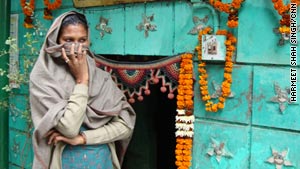
New Delhi's 'eunuchs' forge lives in conservative nation

By Harmeet Shah Singh, CNN
November 15, 2009 7:46 a.m. EST

New Delhi, India (CNN) -- Dotting a crammed neighborhood in the Indian capital are homes that can be easily located without addresses.


Say "hijras," and residents and shop owners at New Delhi's Beri Wala Bagh will give quick directions to houses where India's so-called third gender -- intersex people and eunuchs -- live together in well-kept homes intermingled with businesses and temples.


Intersexual refers to a variety of conditions where there is a discrepancy between a person's external and internal genitals.


On Friday, the groups won a longtime campaign to be listed as "others" instead of male or female, on voting forms. This was seen by many as a way to acknowledge a separate, unique identity.


Despite some strides, the hijras -- loosely called eunuchs in Indian English -- continue to face widespread bias among India's largely conservative population. At one time, eunuchs were valued as trusted loyalists of India's Mughal emperors, in power until the late 19th century.


Hijra homes are their "monasteries" -- each with a revered supreme head, or guruji.


"Our guruji is not in town. Sorry, it's the guruji who can speak, not us," said one resident of the New Delhi neighborhood.


Dressed as a woman, Pavitra, a eunuch from a hijra home designed as a shrine, was willing to help. In her hoarse male voice, she summed up what the community is mostly associated with in modern India.


"We earn our living by blessing and dancing at celebrations," said Pavitra, who uses one name.


Tips from their own network guide them to families celebrating male events: wedding of a son or birth of baby boy.


Most families welcome hijra blessings but dread what they fear could be a curse.


"This is where lies a cultural sanction to their (hijras') existence in India," said Anjali Gopalan, head of the nonprofit Naz Foundation, which campaigns for the rights of sexual minorities in the country.


So while some hijra residents may have sources of economic sustenance, their community remains an object of derision, Gopalan said.


Many third-gender people end up begging in the streets and at traffic intersections. Some turn to prostitution.


In India, most hijras are believed to be eunuchs, or castrated males, and those without economic means adopt a hijra clan.


"They feel like being trapped in a body not their own," Gopalan said, adding that despite many beliefs to the contrary, there was no evidence of forced castration.


Gopalan hailed as a "fabulous step in right direction" India's recent voting rights change, following a long campaign by eunuchs and intersexuals to be listed as "others" instead of male or female on electoral rolls and voter forms.


The groups wanted the option.


However, Gopalan said they remained barred from the rights to inheritance, marriage and the adoption of children.

"It's a whole new journey ahead," Gopalan said.


Asked about her new right as a voter, a smiling Pavita responded, "What will change?"


Before I spoke with her, she didn't know about the option to ask her election officer to replace what she told me was an "M" for male in the gender box of her voter card with an "O." It wasn't clear she wanted to.


Source

Saturday, November 14, 2009

Human Rights Issues for Intersex People In Aotearoa-NZ

By Yann Bradburn.

In July of this year, Mani Bruce Mitchell and I met for an initial talk with the NZ Human Rights Commission on Intersex issues. We were the only intersex people to attend and we met with both the commission plus many professionals with an interest in intersex.

This talk had its origins a few years earlier, when we were asked to discuss whether intersex should be included in a report which had been commissioned on Trans issues. The decision then, was to keep them seperate. Both Mani and I stated we wished intersex to be dealt with later, as we felt the issues could be confused, and that intersex issues are often very different from those of transpeople.

However many intersex people gave submissions through the trans enquiry and this has led the commission to start the first stages on an Intersex enquiry earlier, overlapping into their continued work in addressing transpeoples issues within our country. This is good for us. It also ties into what is happeneing in Australia and NZ is very interested in following what happens there and in Asia. They may be influenced by this; this is yet to be seen.

NZ has a history of setting guidelines for the rest of the world; so we will see.

To read the full report. Visit OII-New Zealand. Click here

Friday, November 13, 2009

OII Australia welcomes changes to New South Wales births registrations for intersex.

Open letter to:

Honourable Lisa Karam and Sharon Swinbourne

My name is Curtis E. Hinkle, the founder and president of the Organisation Intersex International. I have been recently informed of the changes you were instrumental in making in New South Wales concerning birth certificates of intersex citizens there. What you have helped bring about is one of the greatest steps possible for the advancement of human rights for intersex children and adults. I hope that your example will have repercussions elsewhere.

I thank you and send you the respect and gratitude from all the board members of OIl around the world.

With highest regards, Curtis E. Hinkle

For more details, visit OII-Australia: Click here